
How to Search Clark County Traffic Court Records
Traffic and infraction cases filed in Clark County District Court are searchable through the Washington Courts Odyssey Portal. The portal covers active and closed cases, including paid and dismissed infractions. You can look up a case by case number or by party name. The portal does not require a login to see basic public case information, though registered users can view documents. For copies of actual court records, you must contact District Court directly.
Before you start, have your citation number or the full name of the driver listed on the ticket. A case number speeds things up. If you only have a name, be ready for multiple results. Party names must be entered Last, First to match how the clerk entered them.
- Go to the Washington Courts Odyssey Portal and choose Smart Search.
- Enter a case number directly, or type a party name in Last, First order.
- Open Advanced Filtering Options and set Court Location to Clark County, then pick Case Type if you know it.
- Complete the CAPTCHA if it appears, then click Submit to see results.
- Click a case number in the results list to view the case summary, hearing dates, and disposition.
- To pay, contest, or request a certified copy, contact Clark County District Court using the contact details in the sections below.
Note: The Odyssey Portal lists Citation Number as a search type option, but the official user guide says it is not used in the Portal. Search by case number or party name instead.
Which Courts Handle Traffic Cases in Clark County
Clark County District Court handles the large majority of traffic infractions and traffic-related misdemeanors in the county. District Court moved its main location to 210 E. 13th Street, Vancouver, on February 2, 2026. Services that were at the old Franklin Street address shifted to the new building on that date. Any older third-party source listing District Court at the courthouse address is outdated.
The Camas-Washougal Municipal Court handles city-code and some traffic matters for the Camas and Washougal communities. It sits at 89 C Street, Washougal, and operates on a Tuesday and Thursday schedule. If your citation was issued within those city limits, Camas-Washougal Municipal Court is likely the right venue. The table below shows which court covers which type of traffic case.
The screenshot below is from the Clark County District Court official page, which confirms the current address at 210 E. 13th Street and lists contact details for traffic matters.
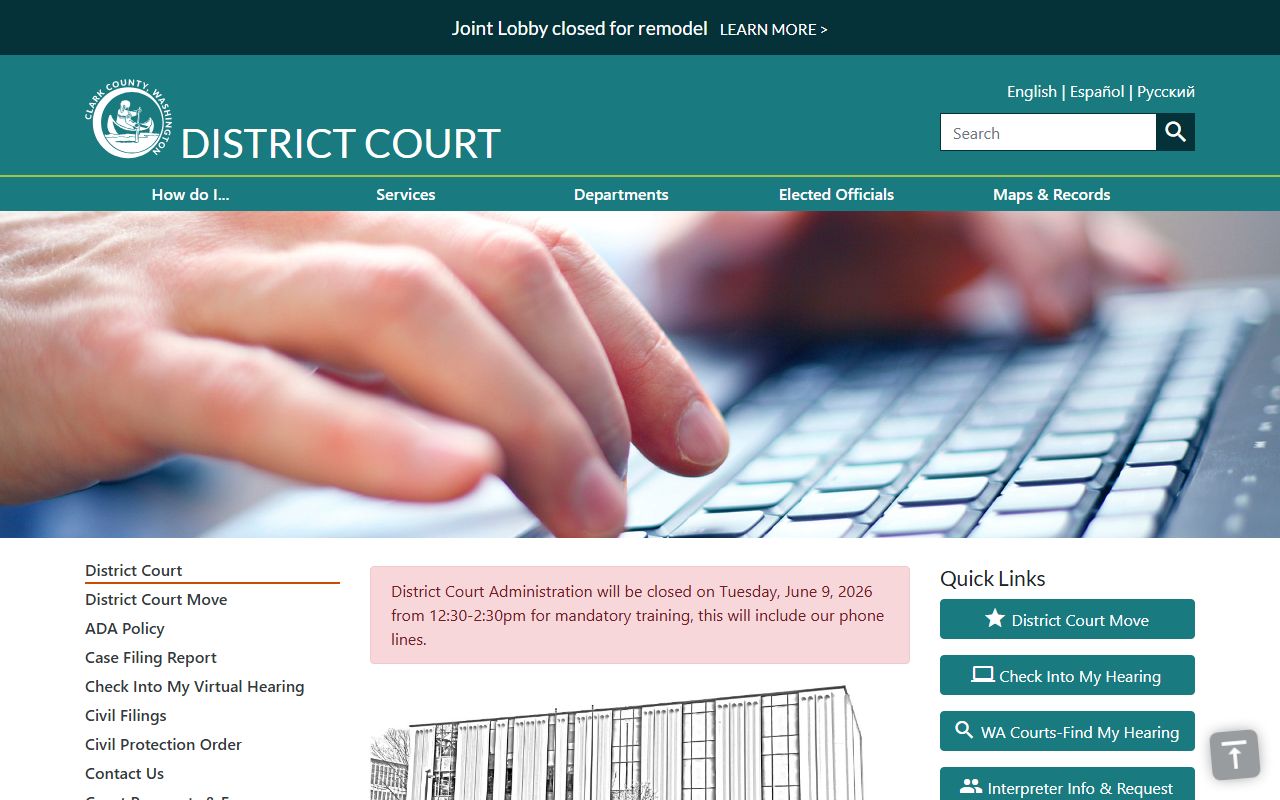
The page lists phone, hours, and mailing address for anyone who needs to reach the court about a traffic case or infraction.
| Court | Traffic Cases Handled | Address | Phone |
|---|---|---|---|
| Clark County District Court | Traffic infractions, traffic misdemeanors, gross misdemeanors, small claims, protection orders | 210 E. 13th Street, Vancouver, WA 98660 | 564-397-2424 |
| Camas-Washougal Municipal Court | City traffic violations, city-code infractions | 89 C Street, Washougal, WA 98671 | 564-397-2125 |
| Clark County Superior Court | DUI cases that rise to felony level, traffic-related felonies | 1200 Franklin Street, Vancouver, WA 98660 | 564-397-2150 |
Types of Traffic Cases on Record
Washington law splits traffic matters into two broad groups: criminal traffic offenses and civil traffic infractions. Criminal traffic offenses, like driving under the influence, reckless driving, and hit and run, can result in jail time and go through the criminal docket. Civil traffic infractions carry a fine but no jail time and are handled on the infraction docket. Most routine citations for speeding, running a red light, or equipment failures are infractions. The type decides how you respond and what the court file looks like.
- Moving violations - Speed, lane change, failure to yield, signal violations, and similar acts while a vehicle is in motion. These show on a driving record.
- Non-moving violations - Equipment defects such as broken lights or expired registration tags, often resolved by fixing the problem and submitting proof.
- Parking citations - Generally handled administratively; may not create a court case unless unpaid and referred for collection.
- Commercial vehicle and CDL violations - Special federal rules apply; no deferred adjudication and mandatory court appearance for many CDL-related charges.
- DUI and criminal traffic offenses - These are criminal, not civil infractions, and route to the criminal docket; DUI cases often appear on the Clark County arrest records page.
District Court's infraction page covers how the court processes civil infractions, including the response deadlines and available options. You can review that detail at clark.wa.gov/district-court/infractions.
What Clark County Traffic Court Records Show
A traffic court record in Clark County holds the formal case data created from the time a citation is filed with District Court through the final resolution. The fields listed below are what you typically see when you open an infraction or traffic case in the Odyssey Portal or request a copy from the court. Not every field appears on every case; older cases or resolved cases may show fewer active fields.
| Field | What It Shows |
|---|---|
| Case Number | The court-assigned identifier for the citation or case; needed for online payment and copy requests. |
| Citation Number | The number on the original ticket issued by the officer; used to locate the matching case number. |
| Charge or Statute | The Washington statute or local code section cited, such as RCW 46.61 for traffic rules of the road. |
| Court Date | The date scheduled for a hearing or mitigation, if one was requested or required. |
| Disposition | The outcome: paid, dismissed, found committed, deferred, or transferred. |
| Fine Amount | The monetary penalty set by the court, plus any fees such as the administrative time-pay fee. |
| Balance Due | The remaining amount owed if the fine has not been paid in full. |
| Parties | The defendant's name and the court location; the state is the opposing party on most infractions. |
| Filing Date | The date the citation was filed with the court, which starts the response deadline clock. |
| Attorney of Record | Shown if a lawyer is entered; many infraction defendants represent themselves. |
The screenshot below is from the District Court infractions page, which explains the options available after receiving a citation and the deadlines for each response.
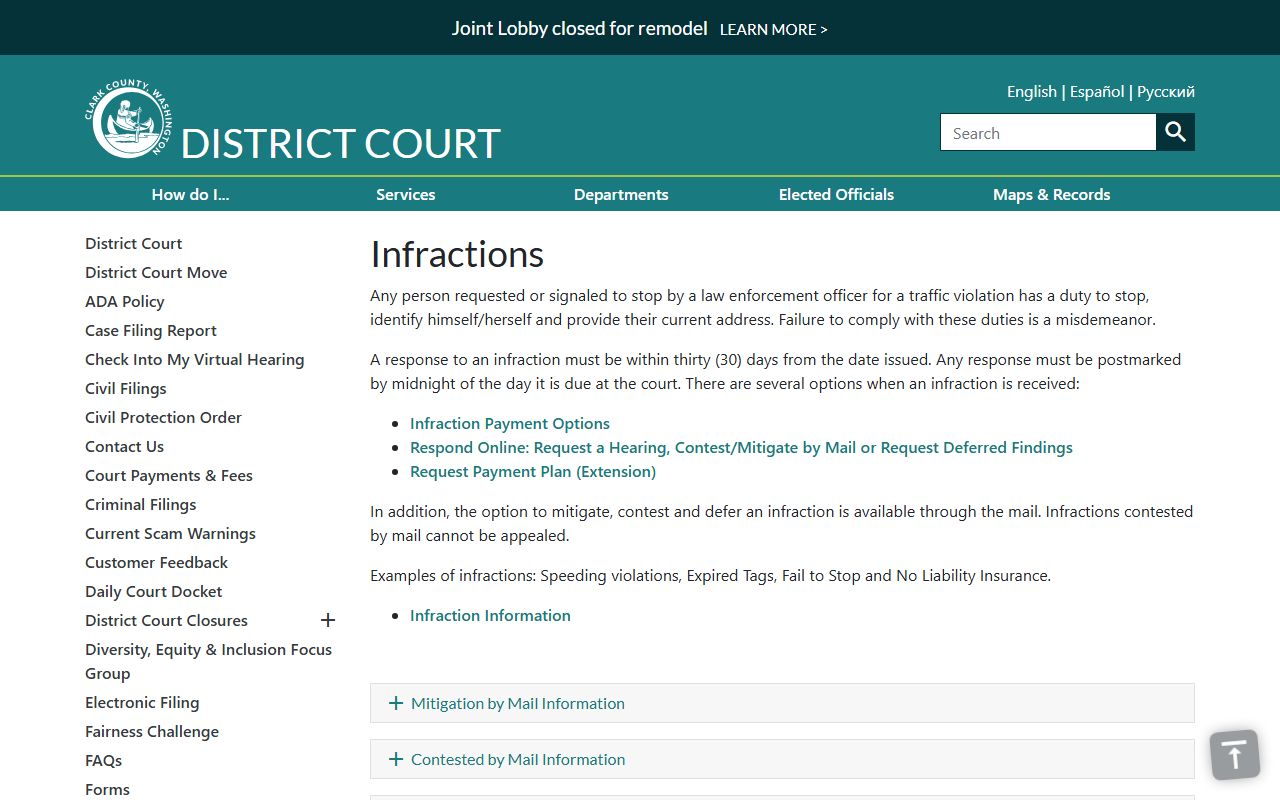
That page outlines the three main responses: pay in full, request mitigation, or request a contested hearing. Each choice has its own deadline and fee implications.
Searching by Citation Number vs by Name
Citation number is the faster method when you have it. The number on the ticket matches one case, so results are direct. Name searches can return multiple records, especially if the name is common. A name search also depends on exact spelling as entered by the clerk, so a typo in the original filing can cause a match to miss. If a name search returns nothing, try alternate spellings or check whether the case is under a different court location.
The table below shows the search fields available through the Odyssey Portal for traffic and infraction cases in Clark County. The Citation Number search type is listed in the portal's options but is noted in the official user guide as not in active use. Use Case Number instead when you have a specific number from the court.
| Search Field | Type | Required | Notes / Format |
|---|---|---|---|
| Smart Search text box | Text | Yes | Enter case number or party name (Last, First); case-insensitive. |
| Case Number | Text / dropdown | No | Most direct; format example: 26-1-00123-06 for a 2026 criminal-type case in Clark County. |
| Party Name | Text | No | Last, First order; anonymous users cannot use wildcard (*) searches. |
| Court Location | Dropdown | No | Select Clark County to filter out cases from other counties in the system. |
| Filed Date | Date range | No | Narrow results by start and end date if you know the approximate citation date. |
| Case Type | Dropdown | No | Traffic infractions are typically criminal or civil type depending on offense. |
Paying or Contesting a Clark County Traffic Ticket
Clark County District Court accepts payment in cash, check, money order, and credit card. Payments can be made in person at the District Court office at 210 E. 13th Street, Monday through Friday, 8:00 a.m. to 4:30 p.m. In-person payment is also available at Camas-Washougal Courthouse, 89 C Street, on Tuesdays and Thursdays. Online payment goes through Point & Pay, which requires a case number and limits each transaction to 10 cases. Mail payments go to Clark County District Court, PO Box 9806, Vancouver, WA 98666-8806, with checks made out to Clark County District Court.
If you cannot pay the full amount at once, a time-payment plan is available through a court-authorized agency. The court adds an administrative time-pay fee of $10 for traffic infractions under RCW 46.63.110(6). All legal financial obligations are due in full upon resolution unless the court orders otherwise.
- Find your case number using the Odyssey Portal or the citation number on your ticket.
- Decide your response: pay in full, request mitigation (ask the court to reduce the fine), or request a contested hearing to dispute the citation.
- Submit your response before the deadline printed on the citation. Deadlines vary; missing them can result in a default finding and added fees.
- If paying online, go to Point & Pay through the District Court payment page and enter your case number. Limit is 10 cases per transaction.
- If paying in person, bring cash, check, money order, or a credit card to 210 E. 13th Street during business hours.
- If requesting a hearing, the court will notify you of a date. Appear on time; failure to appear can result in a bench warrant.
Public Access Laws for Traffic Court Records
Traffic court records in Clark County are public court records under Washington court rule GR 31. GR 31 sets a policy that favors access to court records while protecting personal identifiers. Social Security numbers, financial account numbers, and driver's license numbers are redacted from public copies. This means you can view and request a traffic case file, but sensitive personal data is removed before it is handed over.
District Court administrative records follow a separate rule, GR 31.1. Agency records held by county departments, including some law-enforcement records, fall under the Public Records Act at RCW chapter 42.56 instead. Police reports are not court records; request those directly from the law-enforcement agency that made the arrest or issued the citation. District Court says it cannot create records that do not exist, answer general research questions, or perform legal research on your behalf.
Key Statutes and Rules:
GR 31 - Governs public access to court records statewide; presumes access while protecting personal identifiers.
RCW 46.63.110(6) - Sets the $10 administrative time-pay fee for traffic infractions processed by District Court.
RCW 42.56.030 - Washington's open-government policy for agency public records; exemptions are read narrowly.
Records sealed by judicial order stay closed to the public regardless of these general access rules. If a judge seals a traffic file, you would need a court order to view it. Sealing traffic records is uncommon but possible; more detail is in the sealing section below.
Court Traffic Records vs State Driver Records
Two different files track your driving history in Washington, and they do not always match. The court traffic record is the case file held by Clark County District Court (or Camas-Washougal Municipal Court). It captures what happened in the courtroom: the charge, the plea or finding, the fine, and the disposition. The state driver record is kept by Washington State Department of Licensing (DOL) and tracks what goes on your driving history: convictions, suspensions, points, and license status. A conviction in court flows to DOL as a report, but the court file itself stays with the court. The two are separate files.
If you think the court file contains an error, you contact Clark County District Court. If the DOL record has a mistake, you work with DOL. Correcting one does not automatically fix the other. The table below compares the two.
| Feature | Court Traffic Record | State Driver Record (DOL Abstract) |
|---|---|---|
| Who holds it | Clark County District Court or Camas-Washougal Municipal Court | Washington State Department of Licensing |
| What it contains | Citation, case number, charge, plea, finding, fine, payment status, court dates | Conviction history, license actions, points, suspensions, DUI entries, license status |
| How to access | Odyssey Portal for case lookup; in person, mail, fax, or email to District Court for copies | DOL abstract request; $10 fee at District Court for DOL abstract copy |
| How to correct errors | Contact Clark County District Court at 564-397-2424 or district.courtrecords@clark.wa.gov | Contact Washington State DOL directly |
| Retention | Closed infraction cases kept 3 years; DUI-related cases kept 10 years, then destroyed | DOL sets its own retention schedule; some entries stay on a driver record for years |
Note: District Court can provide a DOL abstract copy for $10, which gives a single document showing the state driver record entry for a specific case.
CDL and Commercial Driver Records
Commercial driver's license holders face stricter rules than regular drivers when a traffic violation is involved. Federal motor carrier regulations prohibit CDL holders from masking violations through deferred adjudication or diversion programs for many offenses committed in a commercial vehicle or in any vehicle in certain CDL-related situations. A court cannot simply dismiss or defer a qualifying CDL violation to keep it off the driving record. The conviction must be reported to DOL, and DOL reports it to the state that issued the CDL.
CDL holders who are cited for serious traffic violations may face mandatory court appearances. Multiple serious violations can lead to disqualification from driving a commercial vehicle, even if the underlying offense would be a minor fine for a regular driver. Employers who require a clean MVR often check both the DOL abstract and any court records. If you hold a CDL and receive a traffic citation in Clark County, confirm with District Court whether a personal appearance is required before your response deadline. The court's infractions page at clark.wa.gov/district-court/infractions explains the general response process.
DUI and DWI Cases in Clark County
Driving under the influence is a criminal offense in Washington, not a civil infraction. A DUI case in Clark County goes through the criminal docket at District Court for a first or second offense at the misdemeanor or gross misdemeanor level. Felony DUI cases, such as vehicular assault or vehicular homicide, go through Clark County Superior Court. Either way, a DUI case creates both a court criminal record and a DOL action against the driver's license.
For full Clark County DUI and criminal traffic case information, see the Clark County arrest records page. District Court keeps DUI-related cases for 10 years before destruction, compared to the 3-year retention for standard infraction cases.
Deferred Adjudication and Defensive Driving
Washington allows a deferred finding on some traffic infractions. Under a deferred finding, the court withholds judgment for a set period. If you complete the conditions, usually staying violation-free and sometimes completing a traffic safety course, the infraction is dismissed. A dismissed deferred infraction typically does not count as a conviction on the DOL driver record, which can protect your insurance rates. Not every infraction is eligible. The court sets the terms at a mitigation or contested hearing.
Defensive driving or traffic safety courses are sometimes offered as a condition of a deferred finding or as part of a mitigation agreement. Washington does not have a statewide universal "traffic school" system that erases points; the availability of a course-based resolution depends on the court's discretion, the violation type, and your driving history. Ask District Court at the time of your hearing whether a deferred finding is available for your specific citation. CDL holders generally cannot use deferred adjudication to mask qualifying commercial-vehicle violations.
Sealing or Expunging Traffic Records
Washington does not use the word "expungement" in its court rules the way some other states do. The process here is called vacation or sealing. For traffic infractions, sealing is uncommon. A civil infraction finding does not typically create a criminal conviction, so the vacation statutes that apply to criminal records, RCW 9.94A.640 for felonies and RCW 9.96.060 for misdemeanors, do not apply in the usual sense. A person might petition the court under GR 15 to seal a specific court file, but the grounds and process differ from criminal vacation.
If a traffic citation was part of a criminal charge that was later vacated, the criminal court file might be sealed, but the separate infraction case stays on its own docket. District Court keeps closed infraction case files for three years and then destroys them. So older infraction records may simply no longer exist in the court system, even if DOL still shows an entry. If you believe a traffic record is affecting your Clark County public records profile or driver record unfairly, consult a licensed Washington attorney about whether any relief applies to your situation.
Court rule GR 15 governs the sealing and redaction of court records in Washington. A judge weighs the request against the public interest before granting any seal. Routine traffic infractions rarely meet that standard on their own.
Fees for Traffic Record Copies
Clark County District Court charges set fees for copies of traffic and infraction case records. The fees come from the court's published schedule at clark.wa.gov/district-court/court-payments-fees. Certified copies carry a higher rate and are needed when you must present a record in a legal or official setting. Non-certified copies are cheaper and work for personal review. Research time is billed separately if staff must search for records beyond a basic case lookup.
The screenshot below is from the District Court Court Payments & Fees page, which lists the full fee schedule for copies, appeals, and other court services.
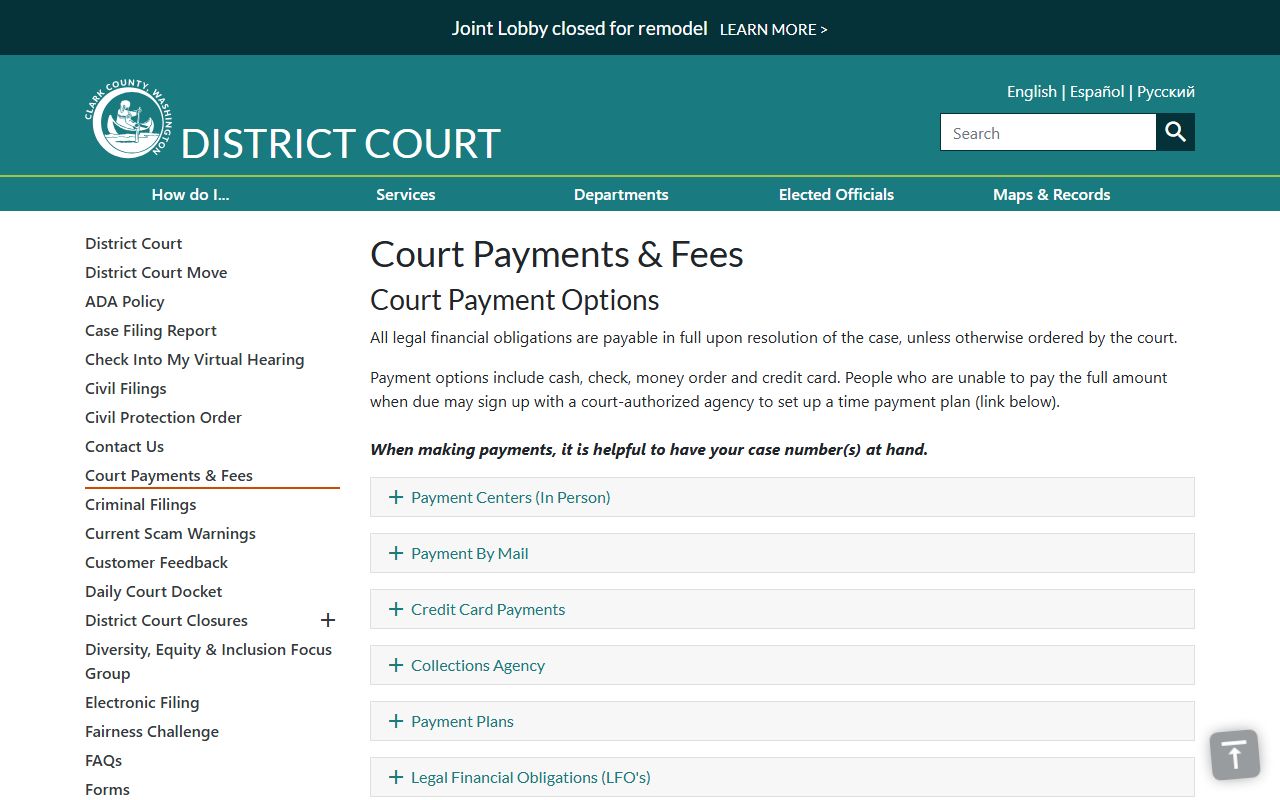
The page confirms payment options and lists exact dollar amounts for each type of copy or service.
| Item | Amount |
|---|---|
| Non-certified copy, per page | $0.50 |
| Certified copy, first page | $5.00 |
| Certified copy, each additional page | $1.00 |
| Copy of court recording or CD | $20.00 |
| DOL abstract copy | $10.00 |
| Research / data dissemination, per hour | $20.00 |
| Administrative time-pay fee (traffic infractions) | $10.00 |
| Appeal filing (civil, infraction, small claims) | $280.00 |
| Designation of record | $40.00 |
Requests can be submitted in person, by mail, by fax to 564-397-6044, or by email to district.courtrecords@clark.wa.gov. The court's public records officer responds within five business days. If the record no longer exists because the retention period passed, the court will say so. Closed infraction cases are kept for three years; DUI-related cases are kept for ten years. After those periods, files are destroyed and cannot be recovered.