
The Two Tracks of Records in Washington
Washington separates public records into two distinct systems. Most people expect one law to cover everything, but that is not how it works here. Agency records, meaning records held by county departments, state offices, and local government bodies, follow RCW chapter 42.56, the Public Records Act. Court case records, meaning the filings, orders, and docket entries in court cases, follow a different set of rules established by the Washington Supreme Court.
For Clark County, this means a request to the Sheriff's Office for a body camera recording is a Public Records Act request. A request to the County Clerk for a copy of a Superior Court order is a court records copy request under clerk fee schedules and court rules. A request to District Court for an infraction case file goes to District Court under its own records procedures. Each track has its own fees, timelines, and exemptions. The distinction matters because sending a Public Records Act request to the wrong office will likely result in a referral to the right one, and that costs time.
The chart below gives a quick map of which law or rule applies and which office handles the request.
| Record Type | Governing Law or Rule | Custodian |
|---|---|---|
| County department records (Sheriff, Auditor, Planning, etc.) | RCW chapter 42.56 (Public Records Act) | The relevant county department's Public Records Officer |
| Superior Court case files | Court rules (GR 31, GR 22, GR 15) | Clark County Clerk |
| District Court case files and administrative records | Court rules (GR 31, GR 31.1) | Clark County District Court |
| Marriage licenses and recorded documents | RCW chapter 42.56 and Auditor statutes | Clark County Auditor |
| Statewide criminal history | RCW chapter 10.97 and WSP rules | Washington State Patrol (WSP WATCH) |
| Jail administrative records | RCW chapter 42.56 via Sheriff | Clark County Sheriff Public Disclosure Unit |
Note: Sending a PRA request for a court case file to a county department will not produce the file because court records are not agency records under RCW 42.56.
The Washington Public Records Act
The Public Records Act, codified at RCW chapter 42.56, is Washington's main open-government law. RCW 42.56.030 sets out a broad policy favoring disclosure. It says the act should be liberally construed and that exemptions should be read narrowly. That means if an agency is unsure whether a record is exempt, the act pushes toward disclosure rather than withholding.
Any person may request records under the act. You do not need to be a Washington resident, a citizen, or a party to any case. You do not have to explain why you want the record. RCW 42.56.070 requires each agency to make its public records available for inspection and copying. Agencies must also maintain indexes, schedules, and procedures that allow the public to identify what records they hold.
There are limits to what an agency must do. RCW 42.56.080 says requests must seek identifiable records. An agency does not have to answer broad research questions, compile statistics, or create a record that does not already exist. Clark County District Court's records page echoes this point directly, telling requesters that it cannot answer general information questions, perform legal research, or create a nonexistent record.
The screenshot below shows the Washington State Legislature page for RCW chapter 42.56, where the full Public Records Act text is published.
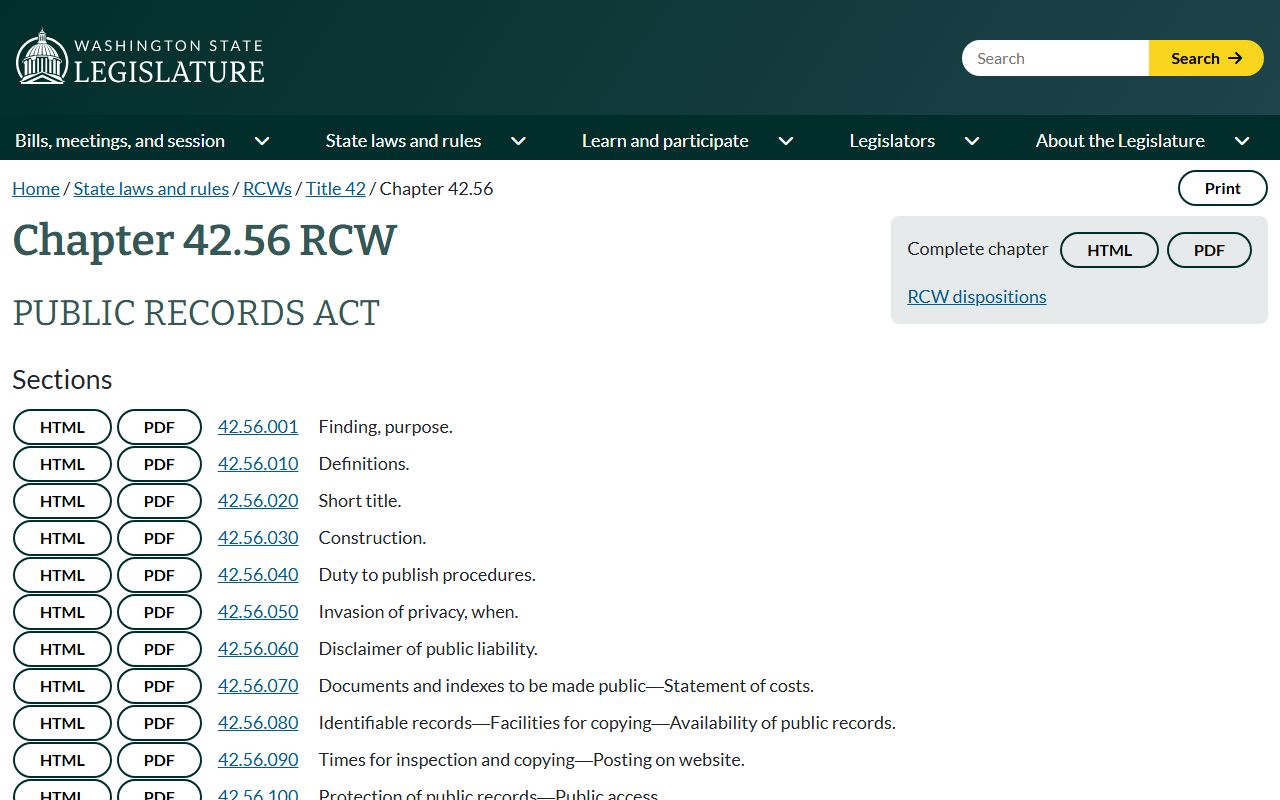
The full chapter covers definitions, construction, fee rules, exemptions, and enforcement. Sections 42.56.210 through 42.56.480 list specific exemption categories that agencies may apply.
Court Records Under GR 31 and GR 31.1
Court case records are not subject to the Public Records Act. Instead, the Washington Supreme Court's General Rules govern how the public gets access to them. GR 31 sets the baseline: there is a strong policy in favor of access to court records. The rule applies to all court records regardless of the medium or storage format, including electronic records. It requires courts to make case records available to the public except where a specific provision restricts access.
GR 31 is not the same as the Public Records Act, even though both favor openness. Court records under GR 31 are requested through the clerk of the court that holds the file. For Superior Court records in Clark County, that is the County Clerk. For District Court records, that is District Court. Each office charges its own fees and sets its own procedures. You cannot file a PRA request with a county department and expect to receive Superior Court case files in return.
GR 31.1 covers a different category: judicial administrative records. These are records about the management and operation of courts and clerks' offices rather than records from specific cases. Budget records, personnel files, and administrative policies of the court are examples. GR 31.1 sets out how those requests are handled and what may be withheld. Family law case files, protection order records, and guardianship files also carry special rules under GR 22, which restricts certain documents and information in sensitive family matters.
Which Office Holds Which Record
Knowing the right custodian is the first step. Clark County splits record-keeping across several offices. Each one handles a distinct set of documents and uses its own request process. The table below maps record types to the office that holds them and the method to request copies.
| Record Type | Custodian | How to Request |
|---|---|---|
| Superior Court case files (felony, civil, divorce, probate, guardianship, juvenile, adoption) | Clark County Clerk | In person, by mail, or email to copyrequests@clark.wa.gov |
| District Court case files (misdemeanors, traffic, small claims, protection orders) | Clark County District Court | Email district.courtrecords@clark.wa.gov or fax 564-397-6044; PO Box 9806, Vancouver, WA 98666-8806 |
| Jail roster and jail administrative records | Clark County Sheriff, Public Disclosure Unit | Contact Sheriff's Public Disclosure Unit; jail roster is posted publicly online |
| Statewide criminal history (conviction data) | Washington State Patrol (WSP WATCH) | Online at watch.wsp.wa.gov; fee applies |
| Marriage licenses and recorded documents (deeds, liens, etc.) | Clark County Auditor | Auditor's office; see County Auditor page for details |
The County Clerk, Scott G. Weber, keeps the official record for every Superior Court case including felony criminal, civil, domestic relations, probate, mental illness, adoption, guardianship, and juvenile offender proceedings. The Clerk assigns case numbers, maintains the court file, processes documents, attends court, and authenticates records for certified copies. The Clerk's office is at 1200 Franklin Street, Vancouver, WA 98660-5000. Copy requests go to copyrequests@clark.wa.gov or by mail to PO Box 5000, Vancouver, WA 98666-5000.
How to File a Clark County Public Records Request
The process below applies to agency records held by county departments such as the Sheriff, the Auditor, and county planning and administrative offices. These records fall under RCW chapter 42.56. For court case files, use the Clerk or District Court copy request process described in the custodian table above.
- Identify the right office. Determine which county department holds the record you want. If you are not sure, call the main county line or check the clark.wa.gov department directory. Sending a request to the wrong office delays your response.
- Describe the record clearly. Write a specific description of what you are looking for. Include names, dates, subject matter, case numbers if you have them, and the format you prefer (paper, electronic, PDF). The more specific you are, the faster the office can find the record. Under RCW 42.56.080, you must request an identifiable record, not a general research question.
- Submit the request. Most Clark County departments accept requests by email, by mail, or in person. Some have online request forms on their department pages. Address the request to the department's Public Records Officer. Include your name and a way to contact you so the office can respond, ask for clarification, or give you a cost estimate.
- Wait for the agency response. Under Washington law, the agency must respond within five business days. The response will do one of the following: provide the records, give an estimated date when the records will be ready, state estimated costs, ask for clarification if the request is unclear, or explain why some or all records are not disclosable. A five-day response does not always mean the records arrive in five days. Large or complex requests may take longer, and the agency will tell you when to expect them.
- Pay any fees and receive the records. If there is a cost, the agency will tell you the amount before producing the records. Pay by the method the office accepts, then collect or download the records. Review them to make sure the response is complete. If records are missing or withheld, you can ask the agency to explain and, if needed, appeal.
For District Court records specifically, the public records officer at District Court follows the same five-business-day response window. The officer will provide records, give an arrival date, state expected costs, request clarification, or explain non-disclosable material. District Court is at 210 E. 13th Street, Vancouver, WA 98660, and PO Box 9806, Vancouver, WA 98666-8806. Records requests go to district.courtrecords@clark.wa.gov or by fax to 564-397-6044.
The screenshot below shows the Clark County District Court records request page at clark.wa.gov/district-court/records-requests, which outlines the process and fees for District Court records.
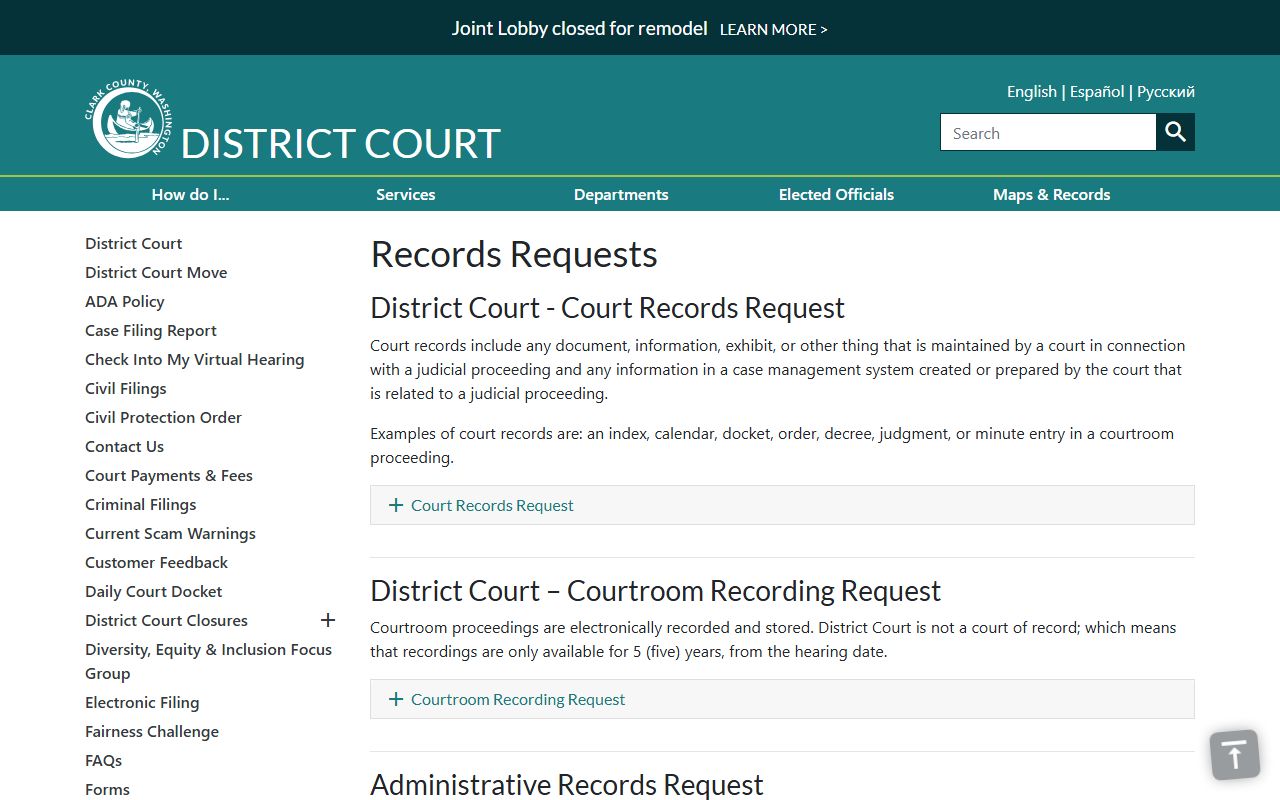
District Court's page also makes clear that the court cannot answer general information questions, perform legal research, or produce a record that does not exist. Those limits come directly from RCW 42.56.080.
Request Form Fields
Whether you use a formal request form or write a letter, include the fields below. A complete request reduces back-and-forth and gets you a faster response. Some county departments use an online form; others accept a free-form email or letter. Either way, the same core information applies.
| Field | Required | Notes |
|---|---|---|
| Your name | Yes | Full legal name so the office can address the response to you. Anonymous requests are allowed under RCW 42.56 but providing a name speeds communication. |
| Contact information | Yes | Mailing address, email, or phone number so the office can respond, give cost estimates, or ask for clarification. |
| Description of records sought | Yes | Be specific: subject matter, names, dates, document type. General research requests are not accepted under RCW 42.56.080. |
| Date range | Recommended | Narrows the search and reduces copy fees. Not legally required but strongly helpful. |
| Case number or reference number | If known | Speeds retrieval considerably. For Clark County Superior Court records, the case number uses a two-digit year, a case-type digit, a sequence number, and the county code 06 (for example, 21-1-01854-06). |
| Format preference | No | Paper copy, electronic PDF, CD, or email delivery. Agencies provide records in their existing format; they are not required to convert formats. |
| Fee waiver request (if applicable) | No | Some agencies allow fee waivers if disclosure is in the public interest. State your basis if you believe a waiver applies. |
For County Clerk copy requests, the Copy Request Form is available on the Clerk's page and should be submitted to copyrequests@clark.wa.gov. Criminal conviction verification requests must be mailed only, not emailed, to Clark County Clerk's Office, Attn. Criminal Department, PO Box 5000, Vancouver, WA 98666-5000.
Copy Fees and Response Timelines
Fees vary by record type and the office that holds the file. The table below covers the main fee schedules for Clark County records. Agency records under the Public Records Act are governed by RCW 42.56.120. Court and Clerk copy fees follow RCW chapter 36.18 and published Clerk schedules. District Court posts its own fee schedule separately.
| Item | Amount | Office |
|---|---|---|
| Non-certified copy, mailed | $0.50 per page | County Clerk (Superior Court) |
| Non-certified copy, emailed | $0.25 per page | County Clerk (Superior Court) |
| Certified copy, first page | $5.00 | County Clerk (Superior Court) |
| Certified copy, each added page | $1.00 | County Clerk (Superior Court) |
| Non-certified 1996-present docs to CD | $0.25 per page + $20 CD/postage | County Clerk (Superior Court) |
| Pre-1996 microfilm search fee | $30 additional | County Clerk (Superior Court) |
| Criminal conviction verification | $5.00 per person | County Clerk (Superior Court) |
| Pre-1979 criminal conviction research fee | $30 additional + copy costs | County Clerk (Superior Court) |
| District Court plain copy | $0.50 per page | District Court |
| District Court certified copy, first page | $5.00 | District Court |
| District Court certified copy, added pages | $1.00 per page | District Court |
| District Court research/staff time | $20.00 per hour | District Court |
| District Court mailing/materials | At cost | District Court |
| WSP WATCH criminal history search | $11.00 per name/DOB | Washington State Patrol |
| WSP WATCH notary request | $15.00 | Washington State Patrol |
Response timelines are set by law and court practice. For agency public records requests under the PRA, the office must respond within five business days. That response confirms receipt and either provides the records, gives an estimated delivery date, states expected costs, asks for clarification, or states why records are not disclosable. The office may take longer than five days to produce the actual records if the request is large or complex, but it must tell you about the delay within that window.
County Clerk copy requests do not follow the five-business-day PRA rule. Instead, processing time depends on the Clerk's workload and whether the request requires a pre-1996 microfilm search. Large requests or archived material can take more time. Check the Clerk's page for current turnaround estimates or call 564-397-2292.
Exemptions and Redactions
Not all Clark County records are open. Both the Public Records Act and court rules identify categories of records that are restricted or that may be partially redacted. An agency that withholds a record must tell you which exemption it is relying on. Partial production with redaction is common: the agency releases the portions that are public and removes the parts that are exempt.
RCW 42.56.230 exempts categories of personal information, including financial account numbers, certain employee and student records, driver's license numbers, and other identifying information. RCW 42.56.540 allows a court to enjoin examination of a specific public record if disclosure would not be in the public interest and would cause substantial irreparable harm to a person or vital government function. GR 31 protects personal identifiers like Social Security numbers in court records.
Specific categories that are closed or restricted in Clark County include the following:
- Adoption records, which the Clerk names as confidential under RCW 26.33.330
- Juvenile records under RCW chapter 13.50, which restricts juvenile justice and care agency records
- Mental illness commitment records, which District Court lists as nonpublic under GR 31/22 and RCW 71.05
- Alcohol and drug treatment commitment records, similarly restricted by District Court
- Police reports, which are law enforcement agency records, not court records; request them from the Sheriff or the relevant agency under the PRA
- Court records sealed by judicial order under GR 15
- Jail records beyond the public roster, which are confidential under RCW 70.48.100
- Personal identifiers such as Social Security numbers, financial account numbers, and driver's license numbers in court records under GR 31
- Non-conviction criminal records at WSP WATCH; conviction data can be released without restriction, but non-conviction information is not available to the public under RCW chapter 10.97
Sealing a court file requires a court order. GR 15 governs the process, which includes procedures for sealing, redaction, and destruction of court records. A judge weighs the request against the public interest before granting or denying a seal. The Washington process for setting aside a conviction is called a "vacation," not an expunction. RCW 9.94A.640 covers felony vacation and RCW 9.96.060 covers misdemeanor and gross misdemeanor vacation. A successful vacation may change what WSP publishes in criminal history, but the court file can still hold docket history unless it is also sealed separately under court rules or statute.
Appeals and Review
If a county department denies your PRA request or redacts records in a way you believe is wrong, you have options. The first step is to ask the agency's Public Records Officer to review the decision. Ask the officer to identify the specific exemption applied and to explain whether any segregable portions of the record can be released. Many partial denials can be resolved at this stage.
For District Court records specifically, the records request page states that if you disagree with a nondisclosure or redaction, you may request a review within 90 days of the public records officer's decision. That request for review goes to the court's designated review authority. Missing that 90-day window can limit your options, so act promptly if you plan to appeal.
For agency records more broadly, RCW chapter 42.56 gives requesters the right to seek a court order requiring disclosure. A requester may file a lawsuit in superior court to enforce the act. Courts can award attorney fees and daily penalties against agencies that improperly withhold records. The Attorney General's office also publishes guidance on the Public Records Act that may help you assess whether a denial is proper.
The screenshot below shows the Clark County Law Library page at clark.wa.gov/law-library. The Law Library, located in the Clark County Courthouse, offers public access to legal resources that can help you research exemptions, appeals procedures, and relevant statutes.
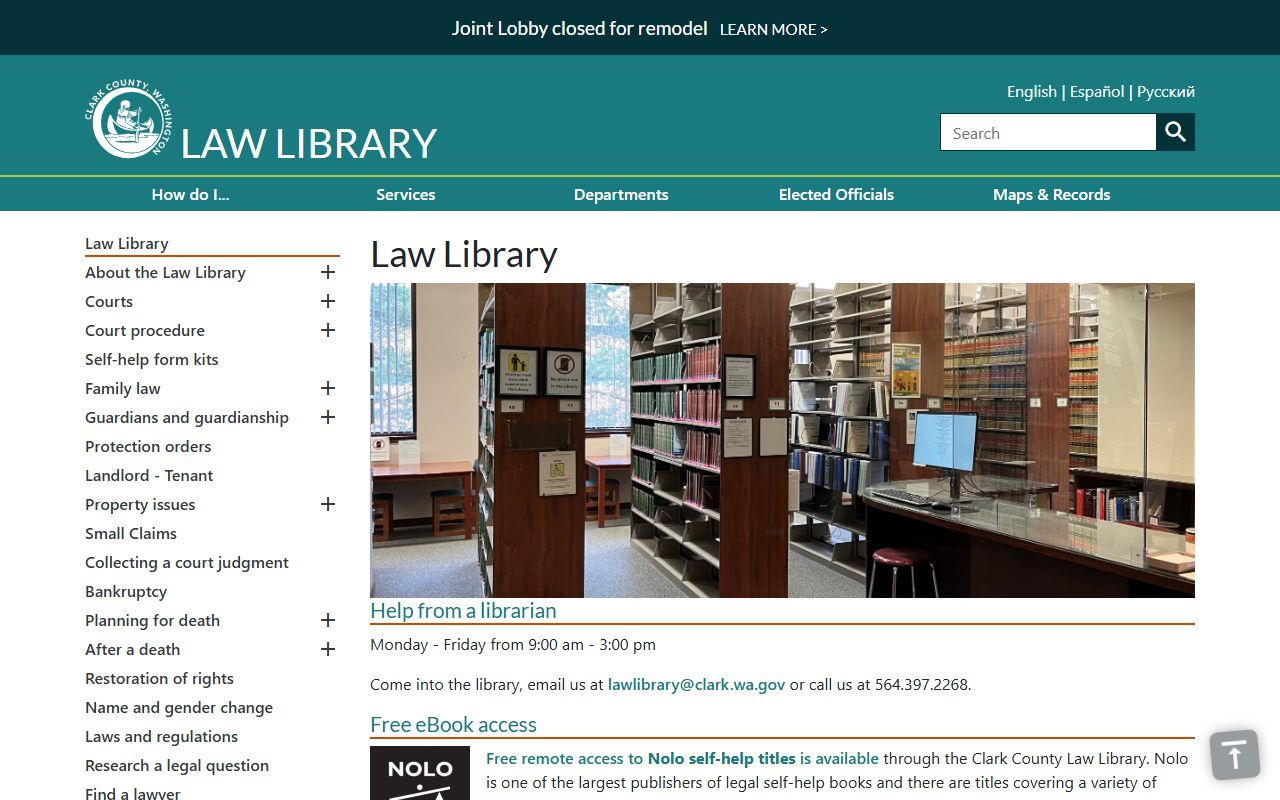
The Law Library staff can point you to the correct research materials, though they cannot give legal advice or represent you in any proceeding.
Important: For court records denied by the County Clerk or District Court, the appeal path goes through the court's review process, not to the Attorney General. Court records are governed by court rules, not the Public Records Act, so the PRA enforcement mechanisms do not apply to them.