
Probate Records in Clark County Superior Court
Clark County has no separate probate court. All probate and guardianship matters are heard in Clark County Superior Court, and the County Clerk is the official record custodian for every case filed there. The Clerk issues letters testamentary and other official documents once the court enters an order. You will not find a standalone probate courthouse or a separate probate clerk window. The same Clerk's office at 1200 Franklin Street that handles civil, family, and criminal filings also handles every estate and guardianship case.
The Superior Court dockets probate cases on a set schedule. The Friday docket at 1:30 p.m. is the main Probate Docket. Minor guardianship matters appear on Tuesday mornings, Thursday afternoons for guardianship reviews, and Friday afternoons. If you need to attend a hearing or verify a hearing date, those are the docket windows to check. Court staff can confirm whether a specific case is on the calendar.
The County Clerk's official probate page at clark.wa.gov/clerk/guardianship-probate-trusts-and-wills covers how the office handles estate filings, guardianships, trusts, and will deposits. That page is the best starting point for understanding which forms to use and what fees apply. The screenshot below shows the Clerk's guardianship, probate, trusts, and wills page, where filing details and local instructions are published.
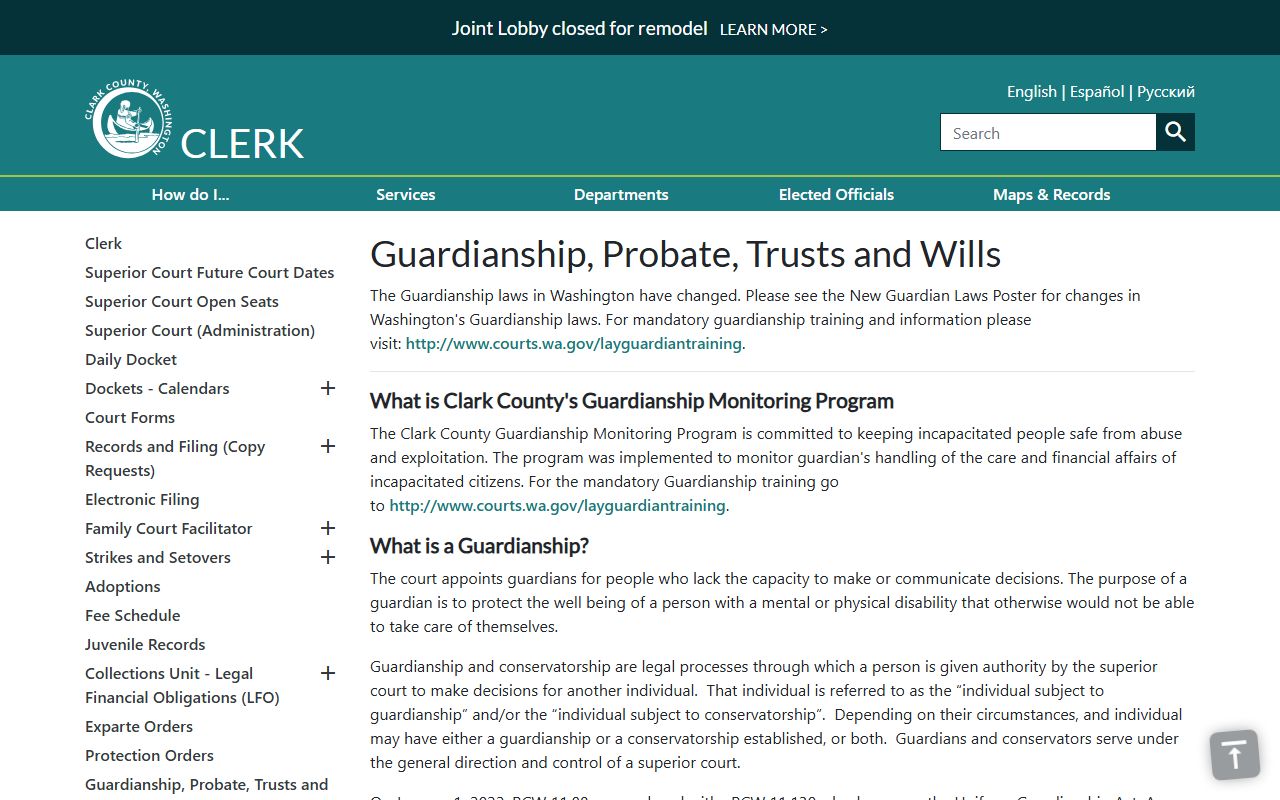
The Clerk's page is updated when fee schedules or procedures change, so check it before you file. Local instructions may differ from the statewide Washington Courts forms packet, and the Clerk recommends confirming form requirements before you submit.
How to Search Clark County Probate Records
Most active Clark County probate records are searchable online. The Washington Courts Odyssey portal covers Superior Court cases, and probate filings fall under case type 4 (Probate/Guardianship) in the portal's filter system. You can search by the estate name, the name of a party such as the personal representative or a creditor, or by case number if you already have one. Older cases and document images may not be in Odyssey at all. For those, the Clerk's public terminals in the lobby and the OnBase subscription system cover probate files going back to 1985 where records have been digitized.
Anonymous users can see public case summaries in Odyssey. They cannot use wildcard name searches. Registered users can add an asterisk at the end of a partial name to broaden a search. Documents themselves are not shown in Odyssey unless the County Clerk has granted document-level access. For actual filings, orders, or certified copies, you contact the Clerk directly.
- Go to the Washington Courts Odyssey Portal and choose Smart Search.
- Enter the estate name or a party name in Last, First format. You can also enter a case number if you have one.
- Click Advanced Filtering Options, set Court Location to Clark County, and set Case Type to 4 (Probate/Guardianship).
- Complete the CAPTCHA if shown, then click Submit.
- Click a case number in the results to view the public case summary, calendar, and docket entries.
- For document images or certified copies, note the case number and contact the County Clerk by phone at 564-397-2292, in person at 1200 Franklin Street, or by mail to PO Box 5000, Vancouver, WA 98666-5000.
Public terminals in the Clerk lobby let walk-in visitors search the case management system and view documents on screen. OnBase is a subscription service for professional users who need regular document access. Both the terminals and OnBase cover Clark County probate public files from 1985 forward where digitized. Pre-1985 records may require a manual search at the Clerk's office.
Note: Odyssey does not show sealed documents or restricted guardianship materials. Contact the Clerk to find out whether a specific file or document has access limits before you travel to the courthouse.
What Probate Covers in Clark County
Probate is the court process for settling a person's estate after death. It also covers guardianship and conservatorship for people who cannot manage their own affairs. In Clark County, Superior Court handles all of it. The case types that fall under the probate docket are broader than most people expect.
- Estate probate - The formal process of proving a will, appointing a personal representative, and distributing assets to heirs and creditors.
- Will-only filing - Depositing a will with the court after death when no full probate is needed.
- Guardianship of a minor - A court order naming a guardian for a child when parents are not able to care for them.
- Guardianship of an incapacitated adult - A court order naming a guardian to make personal decisions for an adult who cannot do so alone.
- Conservatorship - A court order naming a conservator to manage financial affairs for a minor or an incapacitated adult.
- Trust registration and disputes - Trusts may be registered with the court, and trust disputes (TEDRA petitions) are filed in Superior Court.
- Non-probate creditor notices - Creditors may file notice to an estate even when no formal probate is pending.
Small estates may avoid formal probate entirely. Washington law under RCW 11.62.010 allows heirs to collect certain assets using a small estate affidavit rather than opening a full probate case. That affidavit is filed with the Clerk for a $20 fee. Whether a small estate affidavit applies depends on the type and value of assets, so legal advice is often useful before choosing between affidavit and full probate.
Probate and Guardianship Filing Fees in Clark County
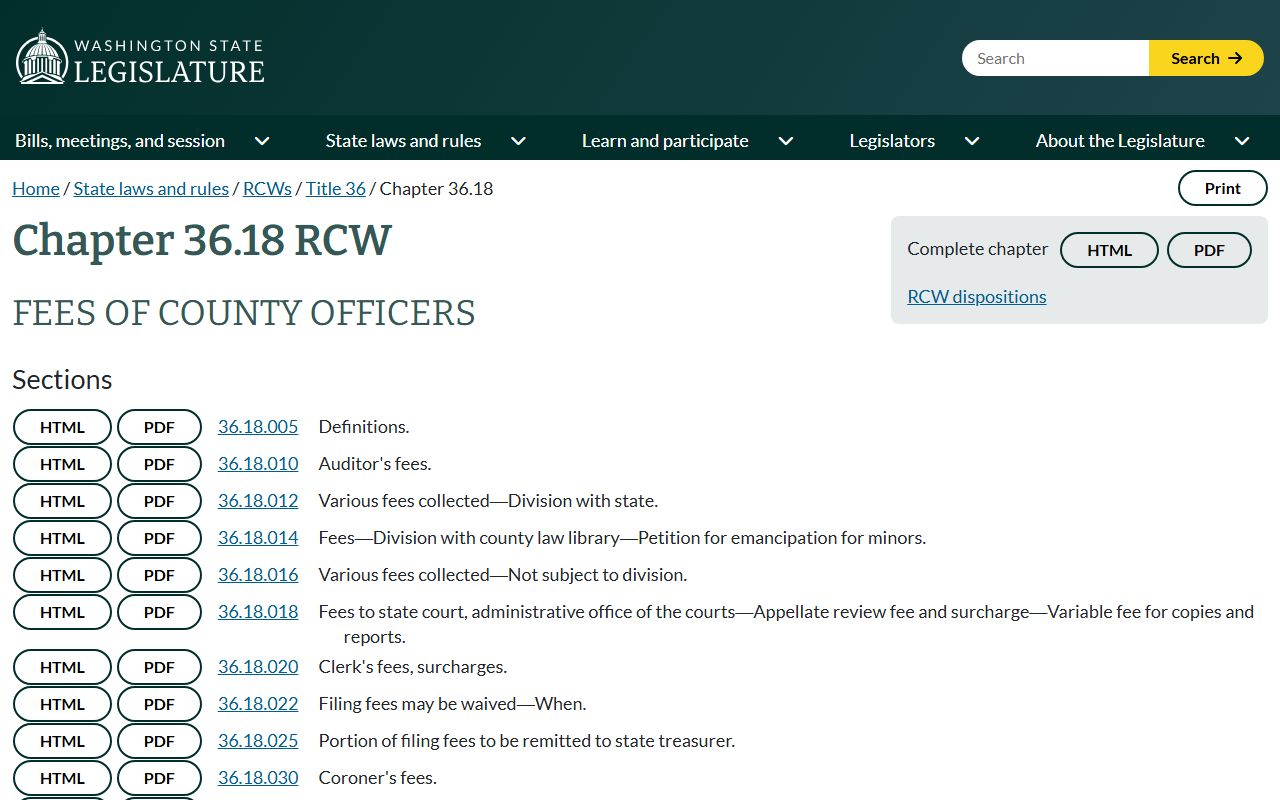
The County Clerk publishes a fee schedule for probate and guardianship filings. Most fees are set by RCW 36.18, which governs clerk fees statewide. The full schedule is at the official Clark County Clerk fee schedule page. The screenshot below shows the RCW 36.18 statute page where probate filing fee authority is found.
| Item | Fee | Notes |
|---|---|---|
| Estate (Probate) filing | $290 | Opening a probate estate case |
| Guardianship filing | $290 | No fee when case assets are under $3,000 |
| Certificate of Qualification | $5 | Form K issued by Clerk |
| Letters (Administration, Testamentary, or Guardianship) | $5 | Each issuance with court seal |
| Non-Judicial Resolution in existing case | $20 | RCW 11.96A.220 |
| Non-Probate Notice to Creditors | $290 | RCW 11.42.010 |
| Notice of Probate filed in another county | $20 | RCW 11.40.020; when decedent resided elsewhere |
| TEDRA petition (will or trust dispute) | $290 | Trust and estate dispute resolution |
| Petition to admit rejected will | $290 | |
| Trust registration | $290 | |
| Small Estate Affidavit | $20 | RCW 11.62.010 |
| Blank forms | $4 | Small estate form packet |
| Will-only after death, no probate | $20 | Filing only; no estate opened |
| Will Repository before death | $20 | Per will or codicil; sealed until death |
Certified copies of probate documents cost $5 for the first page and $1 for each additional page. Payment methods at the Clerk include cash, debit or credit card with a convenience fee, cashier's check, and money order. Personal checks are not accepted.
Wills and the Will Repository in Clark County
Clark County offers three distinct ways a will can come before the Clerk, each with a different fee and purpose. Knowing which applies to your situation saves time and avoids a misfiling.
The first option is the Will Repository. While a person is still alive, they can deposit an original will or codicil with the County Clerk for safekeeping. The Clerk seals and holds the document until the depositor's death. This costs $20 per will or codicil. The will stays sealed while the person lives, and no one can access it without a court order or proof of death. This service protects against the will being lost, destroyed, or contested later on the ground that no one knows where the original is.
The second option is a will-only filing after death. When a person has died and there is a will, but the estate does not need full probate because assets passed by beneficiary designation, joint tenancy, or trust, the will itself can still be filed with the Clerk. The cost is $20. No estate case is opened. The filing creates a public record that the will exists and was admitted to the Clerk, which can matter for title purposes later.
The third option is full estate probate. This opens a Superior Court case, requires a $290 filing fee, and triggers the full probate process including appointment of a personal representative, creditor notice, inventory, and final accounting. Not every estate needs to go this route. The small estate affidavit under RCW 11.62.010 may apply for smaller or simpler estates. The distinction between these three paths is the most important thing to sort out before you go to the Clerk's window.
Small Estate Affidavit in Clark County
Washington allows heirs to collect certain assets without opening a full probate case by using a small estate affidavit. The authority is RCW 11.62.010. The affidavit states that the person claiming the asset is entitled to it and that the total value of the estate is within the statutory limit. Filing the affidavit with the Clerk costs $20, and blank form packets are available for $4.
The affidavit approach works for bank accounts, vehicles, and similar personal property in many cases, but it does not transfer real estate. If the estate includes real property, a deed to clear title typically requires a full probate or another court process. The County Clerk can tell you which form to use, but staff cannot advise you on whether the affidavit applies to a specific estate. A consultation with an attorney or the Family Court Facilitator may help clarify which path fits your situation.
Note: The small estate threshold and eligible asset types can change when the legislature amends RCW 11.62. Always confirm the current limits with the Clerk or official Washington Courts materials before relying on the affidavit option.
Guardianship Records in Clark County
Guardianship cases are filed in Clark County Superior Court along with probate. They appear on the same Odyssey case type 4 filter and are kept by the same County Clerk. But guardianship records can be more restricted than estate records. A guardianship file for a minor or an incapacitated adult often contains medical evaluations, financial inventories, and sensitive personal information about the ward.
Washington court rule GR 22 (available at courts.wa.gov court rules GR 22) addresses access to records with personal and financial identifiers. Certain guardianship documents may be restricted under GR 22 or sealed by court order. If a file you want to view has a restriction, the Clerk will tell you what level of access is available without a court order. Requesting access to sealed guardianship materials requires a motion and a judge's approval.
Ongoing guardianship cases require regular court reporting. The guardian files inventories, annual accountings, and status reports with the Clerk. Those filings are part of the case record and, unless sealed, are public. The court reviews them to confirm the guardian is acting in the ward's best interest. Superior Court minor guardianship dockets run Tuesday mornings, Thursday afternoons, and Friday afternoons. If you need to monitor an active case, Odyssey shows the docket and hearing dates without restriction for public case events.
How Probate Works in Clark County
Opening and closing a probate estate in Clark County follows a set sequence. Most steps are governed by state statutes in Title 11 RCW. The steps below reflect the standard path for a formal estate probate. Some steps may differ for small estates, intestate estates, or cases where heirs dispute the will.
- Determine whether formal probate is required or whether a small estate affidavit under RCW 11.62.010 applies to the assets in the estate.
- File the probate petition in Clark County Superior Court if venue is proper, meaning the decedent resided in Clark County or owned real property there.
- Pay the $290 estate filing fee to the County Clerk at 1200 Franklin Street, or by mail to PO Box 5000, Vancouver, WA 98666-5000.
- Present the original will to the court and seek appointment of a personal representative. If there is no will, seek appointment of an administrator and the court will apply Washington intestate succession law.
- Obtain certified letters testamentary or letters of administration from the Clerk after the court enters the appointment order. Letters cost $5 each and are the documents that give the personal representative legal authority to act for the estate.
- Provide required notice to heirs, beneficiaries, and creditors as set out under RCW 11.40 and related statutes. Creditors typically have a set period to file claims after notice.
- File an inventory and accounting of estate assets with the court as required by the judge or applicable statutes.
- Resolve creditor claims, pay estate debts, handle any tax obligations, and transfer or sell property as needed.
- Close the estate by filing a declaration or petition for order of distribution once all obligations are met and all assets have been transferred or accounted for.
The whole process can take a few months for a simple estate or more than a year when there is real property, disputes, or complex tax issues. The Family Court Facilitator at the courthouse handles civil self-help matters and may be able to point you to resources, though they do not provide legal advice specific to your case.
Clark County Probate Terms Defined
Probate filings use legal terms that can be confusing the first time you read a case file. These definitions cover the most common ones you will find in Clark County Superior Court probate records.
- Testator
- The person who made a will. When the testator dies, the will is submitted to the court for probate.
- Executor / Personal Representative
- The person named in a will (executor) or appointed by the court (personal representative) to manage and settle the estate. Washington statutes use the term personal representative for both.
- Intestate
- Dying without a valid will. The court appoints an administrator and Washington intestate succession law decides how assets are distributed.
- Guardianship
- A court order giving one person authority to make personal decisions for another, such as where they live or what medical care they receive, because that person cannot make those decisions alone.
- Conservatorship
- A court order giving one person authority to manage the financial affairs and property of another person who cannot do so because of age or incapacity. A conservator handles money; a guardian handles personal care. One person can hold both roles.
- Letters Testamentary / Letters of Administration
- Official documents issued by the County Clerk after the court appoints the personal representative. Banks, title companies, and agencies require these letters before they will work with the estate. Each issuance costs $5 in Clark County.
Restricted Probate Documents in Clark County
Most probate records are public court records under Washington court rules. Anyone can view the case docket in Odyssey and request copies from the Clerk. But some documents within a probate or guardianship file may be sealed or restricted.
A judge may seal specific records on request if there is a strong reason, such as protecting a minor's identity or shielding medical information from public view. Sealed records do not appear in Odyssey searches and cannot be accessed at the public terminals without a court order. Guardianship files are the most common source of restricted documents. Medical evaluations of an incapacitated ward, financial inventories, and reports from appointed guardians ad litem may carry restrictions under court rule GR 22.
If you are searching a probate case and find that documents are missing or blocked, contact the County Clerk at 564-397-2292 to ask about the restriction. If you have a legal basis to request access, such as being a named heir or having a financial interest in the estate, a motion to the court may be the path forward. The County Clerk page has more on how to request copies and how to handle restricted materials. For broader access questions, the Clark County court records page covers the GR 31 and GR 22 framework in more detail.
Clark County Probate Office Contact
Probate and guardianship filings go to the County Clerk, not to a separate probate division. The Clerk's office at the Clark County Courthouse handles intake, fees, and record access for all Superior Court cases including estates and guardianships. The contact information below is for the Clerk's office, which manages the probate docket in coordination with Clark County Superior Court.
Clark County Clerk (Probate & Guardianship)
1200 Franklin Street
Vancouver, WA 98660-5000
PO Box 5000, Vancouver, WA 98666-5000 (mail)
564-397-2292
Mon-Fri 9:00 a.m.-4:30 p.m.
For marriage and divorce records, note that marriage licenses go to the County Auditor, not the Clerk. Divorce and dissolution records are with the Clerk because those are Superior Court cases, just like probate. The County Clerk page covers all the record types the Clerk maintains and the full fee schedule.